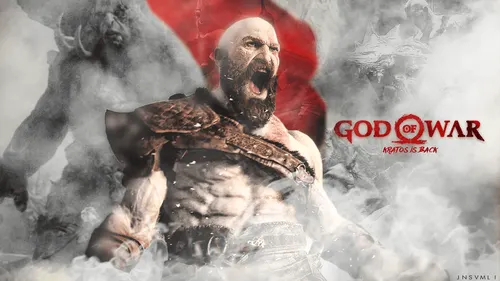
Few franchises have reinvented themselves as successfully as God of War.
After years of brutal combat, Greek mythology, and endless rage, many believed Kratos’ story had reached its conclusion. Instead, Santa Monica Studio accomplished something extraordinary: they transformed one of gaming’s most violent antiheroes into the centerpiece of a deeply emotional journey about fatherhood, grief, responsibility, and redemption.
Released in 2018, God of War was not merely a sequel.
It was a rebirth.
And one of the greatest video games ever made.
A New Beginning
Years after the destruction of Olympus, Kratos lives in the harsh wilderness of Midgard.
The Ghost of Sparta has abandoned Greece and now resides in the world of Norse mythology with his young son, Atreus.
Following the death of Atreus’ mother, the two embark on a journey to fulfill her final wish: scatter her ashes from the highest peak in all the realms.
What begins as a simple quest gradually evolves into an epic adventure involving gods, monsters, ancient prophecies, and revelations that change everything.
Yet despite its massive scope, the story remains intensely personal.
At its core, God of War is about a father trying—and often failing—to connect with his son.
Kratos Reborn
The most impressive achievement of God of War is its portrayal of Kratos.
The raging warrior from the Greek saga still exists beneath the surface.
But age, loss, and regret have transformed him.
This version of Kratos is quieter.
More thoughtful.
More dangerous.
Every word feels deliberate.
Every action carries weight.
His struggle is no longer against gods.
It is against himself.
Watching Kratos attempt to become a better man—and a better father—is one of the most compelling character arcs in gaming history.
Atreus: More Than a Sidekick
Many games struggle to make companion characters enjoyable.
God of War succeeds brilliantly.
Atreus is not a burden.
He is the heart of the story.
Throughout the journey, players witness his growth from an insecure child into a capable warrior.
His curiosity, intelligence, and emotional complexity create a fascinating contrast with Kratos’ stoicism.
The relationship between father and son drives the entire experience.
Every victory, argument, and quiet conversation strengthens the emotional impact of the narrative.
Norse Mythology Brought to Life
Just as the original games explored Greek mythology, God of War immerses players in Norse legends.
The world is filled with:
- Ancient gods
- Giants
- Dragons
- Valkyries
- Dwarves
- Mythological creatures
Unlike many fantasy settings, the mythology feels deeply integrated into the world.
Characters constantly reference legends, prophecies, and historical events.
The result is a setting that feels rich, believable, and endlessly fascinating.
The Leviathan Axe
One of the game’s most iconic additions is the Leviathan Axe.
Replacing the Blades of Chaos as Kratos’ primary weapon, the axe immediately became one of gaming’s greatest weapons.
Its defining feature is simple:
You can throw it.
And call it back.
The mechanic never stops feeling satisfying.
Whether solving puzzles, freezing enemies, or recalling the weapon after a perfectly aimed throw, the Leviathan Axe delivers an unmatched sense of power.
It is one of the finest weapon designs ever created.
Combat: Brutal and Tactical
The combat system represents a dramatic departure from earlier entries.
Instead of chaotic crowd battles, encounters feel more deliberate and intimate.
Players must master:
- Positioning
- Dodging
- Blocking
- Parrying
- Ability management
- Weapon switching
Every enemy feels dangerous.
Even basic encounters require attention.
The result is combat that remains exciting throughout the entire adventure.
It is brutal without becoming mindless.
The One-Shot Camera
Perhaps the game’s most ambitious technical achievement is its camera.
From beginning to end, the entire game appears to unfold in a single uninterrupted shot.
There are:
- No visible cuts
- No traditional loading screens
- No cinematic transitions
The camera never leaves the characters.
This creates an extraordinary sense of immersion.
Players feel as though they are experiencing the journey alongside Kratos and Atreus rather than simply observing it.
World Design
Unlike the older games’ linear structure, God of War introduces semi-open environments connected through exploration.
Players can discover:
- Hidden realms
- Side quests
- Ancient ruins
- Powerful equipment
- Secret bosses
Exploration feels consistently rewarding.
The Lake of Nine serves as a central hub that gradually reveals new opportunities throughout the adventure.
Every return uncovers something new.
Visual Presentation
Even years after release, God of War remains stunning.
The game combines:
- Detailed character models
- Beautiful lighting
- Incredible animations
- Spectacular environments
From frozen mountains to mystical forests and ancient temples, every location feels handcrafted.
Few games achieve this level of visual consistency.
Music and Atmosphere
The soundtrack, composed by Bear McCreary, is exceptional.
Its powerful orchestral themes perfectly capture the game’s emotional range.
The main theme alone has become one of gaming’s most recognizable musical pieces.
Combined with outstanding voice acting and environmental storytelling, the atmosphere is unforgettable.
Boss Battles
While some players criticized the number of troll encounters, the major boss fights are spectacular.
Highlights include confrontations with:
- Baldur
- Dragons
- Valkyries
- Ancient beings
The battle against Baldur in particular remains one of the greatest opening boss fights ever created.
The sheer intensity immediately establishes the game’s new direction.
Themes of Fatherhood and Redemption
What truly elevates God of War beyond most action games is its thematic depth.
The story explores:
- Grief
- Responsibility
- Legacy
- Trust
- Parenthood
- Redemption
Kratos’ greatest challenge is not defeating monsters.
It is teaching Atreus without passing on the mistakes that destroyed his own life.
This emotional foundation gives every moment greater meaning.
The Weaknesses
Despite its brilliance, the game is not flawless.
Some enemy types are reused too frequently.
A few RPG mechanics feel unnecessary.
Certain side bosses lack variety.
However, these criticisms are relatively minor compared to the overall quality of the experience.
Why God of War Matters
Many franchises survive by repeating successful formulas.
God of War succeeded because it had the courage to change.
Santa Monica Studio transformed a beloved action series into something more mature, emotional, and ambitious without sacrificing what made it fun.
That balance is extraordinarily difficult to achieve.
Yet God of War accomplishes it almost perfectly.
Verdict
God of War (2018) is one of the finest video games ever made.
Its exceptional storytelling, unforgettable characters, satisfying combat, breathtaking world design, and emotional depth combine into an experience that transcends the action genre.
This is not simply a great sequel.
It is a masterclass in how to reinvent a franchise.
Few games are remembered as turning points for an entire medium.
God of War deserves to be one of them.
Score: 10/10
Pros
- Masterful story
- Outstanding character development
- Incredible combat system
- Exceptional world design
- Beautiful visuals
- Fantastic soundtrack
- Emotional depth rarely seen in games
Cons
- Repetitive minor boss encounters
- Some RPG elements feel unnecessary
- Limited enemy variety in certain sections
Final Verdict: A modern masterpiece and one of the greatest action-adventure games ever created.