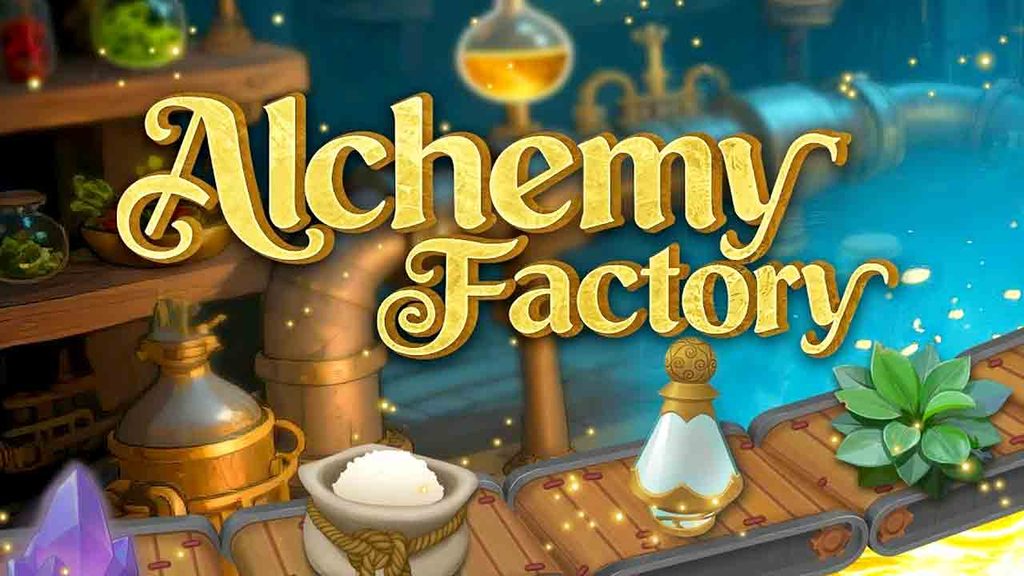
If you’re searching for Alchemy Factory free download, you’re probably looking for a game that combines medieval fantasy with automation, crafting and business management.
Alchemy Factory puts me in the role of an aspiring alchemist who starts with a small workshop and gradually turns it into a massive automated production empire.
Developed by D5 Copperhead and published by Gamirror Games, the game officially launched version 1.0 in September 2026 after its Early Access period.
What immediately caught my attention is the combination of systems. I’m not just making potions. I’m designing production lines, moving resources through pipes and conveyor belts, managing a shop and trying to make the whole operation as efficient as possible.
What Is Alchemy Factory?
Alchemy Factory is a medieval-themed automation and management simulation.
The basic idea is simple: start small, produce alchemical goods and gradually build a huge factory capable of handling increasingly complicated production chains.
I can grind herbs, extract essences, distill potions, process metals and eventually create more valuable products.
The game essentially asks me to transform a small magical workshop into an industrial-scale alchemy business.
And that’s where the automation comes in.
Building an Automated Alchemy Factory
The heart of the game is production automation.
Instead of manually processing every ingredient, I can connect machines with conveyor belts and pipes.
Materials move through the factory automatically, allowing me to create production chains that handle different stages of crafting.
This creates the classic satisfaction found in automation games: I start with something complicated and gradually figure out how to make it run without constant intervention.
The official Steam description specifically highlights grinding, extracting, distilling, smelting and processing materials as part of these automated production chains.
Conveyor Belts and Pipes
The factory isn’t just a collection of machines.
I have to think about how everything connects.
Conveyor belts transport solid materials, while magical liquids can be moved through arcane pipe networks.
As the factory grows, organization becomes increasingly important.
A poorly designed production line can create bottlenecks, while a well-planned factory can keep materials moving continuously.
This is probably the part of Alchemy Factory that will appeal most to players who enjoy games such as Factorio, Satisfactory or other automation-focused simulations.
Running a Medieval Shop
Production isn’t the only objective.
I’m also responsible for selling what my factory produces.
Potions, jewelry, relics and other alchemical products can be placed in the shop, turning the factory into an actual business.
This adds another layer to the gameplay.
I’m not simply asking, “How can I produce more?”
I’m also asking, “What should I produce, and how can I make money from it?”
The 1.0 update expanded this side of the game with a revamped shopkeeping system and additional logistics features.
From Apprentice to Alchemy Tycoon
Progression is built around expanding the operation.
I begin as a relatively small alchemist, but eventually I can create a much larger production network.
The goal isn’t simply to unlock a new machine every few minutes.
It’s about building an increasingly efficient business.
As my production chains become more complicated, I have to rethink the layout of my factory and find better ways to move resources.
That constant optimization is what gives the game its addictive quality.
Voxel-Based Factory Building
One feature I particularly like is the voxel-style building system.
Machines and conveyor belts can be arranged almost like building blocks.
This makes designing the factory feel more accessible than systems where I have to worry about extremely precise placement.
It also gives me plenty of freedom to experiment with different layouts.
I can build vertically and create increasingly elaborate production facilities instead of limiting myself to a flat workshop.
Portal-Powered Logistics
The 1.0 release introduces the Grand Portal and a new Wagon Logistics System.
These systems are designed to make transportation more efficient as the factory expands.
This is important because logistics can become one of the biggest problems in automation games.
A production line might work perfectly on a small scale, but once the factory becomes enormous, moving resources between different areas can become a nightmare.
The magical setting gives Alchemy Factory a fun solution: instead of relying entirely on conventional logistics, I can eventually use magical transportation systems.
Multiplayer
Alchemy Factory isn’t strictly a single-player experience.
The game supports online cooperative multiplayer as well as LAN co-op.
This means I can invite friends to help design and optimize the factory.
And honestly, automation games can be surprisingly fun in multiplayer.
One player can focus on resource processing while another designs transportation systems or manages the shop.
Of course, there’s always the possibility that someone creates a production line that makes absolutely no sense.
That’s part of the fun.
The Medieval Setting
The medieval fantasy setting gives the game a different personality from traditional industrial automation games.
Instead of factories filled with modern machines, I’m dealing with magical devices, potions, herbs, metals and arcane technology.
The result is a strange but appealing combination of fantasy and industrialization.
I’m essentially building a magical manufacturing company.
Graphics and Presentation
Alchemy Factory uses a stylized 3D visual design that fits its sandbox mechanics.
The voxel-inspired construction system makes factories easy to understand visually, while the medieval setting gives the production areas a distinctive appearance.
The graphics aren’t trying to compete with huge AAA RPGs.
That’s not really the point.
The focus is on making the factory readable and giving me enough visual information to understand how my production systems are working.
System Requirements
One advantage of Alchemy Factory is that it doesn’t require an extremely powerful PC to meet its minimum requirements.
The official Steam requirements list:
- Windows 10 64-bit or later
- Intel i5-3570 3.4 GHz or equivalent
- 8 GB RAM
- NVIDIA GTX 1060 or AMD RX 470/RX 570
- DirectX 11
- 3 GB available storage
The recommended configuration increases the requirements to 16 GB RAM, a Ryzen 5 5600X or Intel i5-12400, and an RTX 2070 or RX 5700.
The game also supports Brazilian Portuguese interface and subtitles.
Is Alchemy Factory Worth Playing?
If you enjoy automation and management games, I think Alchemy Factory is worth checking out.
What makes it interesting is the combination of several genres.
It’s part factory automation game, part shop-management simulator and part medieval crafting sandbox.
The 1.0 release also makes this a particularly interesting time to start playing because major systems from the Early Access roadmap have now been implemented, including the Grand Portal, Wagon Logistics System, revamped reputation system and improved shopkeeping.
The game also currently has a Very Positive overall rating on Steam, based on thousands of user reviews.
Alchemy Factory Free Download
If you’re searching for an Alchemy Factory free download, it’s important to clarify that the full game is not officially free.
The legitimate PC version is available through Steam as a paid game. Steam also offers a demo, giving players an opportunity to try the game before purchasing it.
I recommend using the official version rather than downloading unauthorized copies from third-party websites. Apart from copyright concerns, unofficial game files can potentially contain unwanted or malicious modifications.
Final Verdict
Alchemy Factory is an interesting combination of medieval fantasy, automation and business simulation.
I like the fact that the game doesn’t stop at crafting potions.
I’m building production lines, managing logistics, selling products and gradually turning a small workshop into a large-scale magical business.
The automation mechanics give me plenty of opportunities to optimize my factory, while multiplayer makes it possible to build and experiment with friends.
The move to version 1.0 also makes the game more attractive for new players who prefer starting with a more complete experience rather than joining during Early Access.
My Rating: 8.5/10
Pros
- Fun automation mechanics
- Medieval fantasy setting
- Deep production chains
- Factory customization
- Shop management
- Multiplayer support
- Voxel-based construction
- Relatively small storage requirement
- Brazilian Portuguese support
Cons
- Can become complex as the factory expands
- Automation gameplay isn’t for everyone
- Some systems require experimentation
- The game can be overwhelming for players unfamiliar with factory simulators
Alchemy Factory FAQ
Is Alchemy Factory free?
No. The full game is a paid title on Steam. A demo is also available for players who want to try it first.
Can I play Alchemy Factory with friends?
Yes. The game supports online cooperative multiplayer and LAN co-op.
Is Alchemy Factory still in Early Access?
No. The game moved to version 1.0 in September 2026 after its Early Access period.
How much storage does Alchemy Factory require?
The official minimum requirement is 3 GB of available storage.
Does Alchemy Factory support Portuguese?
Yes. Brazilian Portuguese is supported for the interface and subtitles.
What kind of game is Alchemy Factory?
It’s a medieval automation and management game combining factory building, crafting, resource management, shopkeeping and sandbox construction.